


CAPM or PMP? Read This Before You Waste Months Studying
Choosing a PMI certification is not just an academic choice. It is a professional risk decision. It affects how much time you invest, how much money you spend, and how prepared you are for one of the most demanding professional exams in project management. Many candidates make this decision based on popularity, salary claims, or peer pressure. That approach often leads to failure, wasted effort, or long delays in career growth.
This guide is written for serious PMP exam candidates and aspiring project professionals who want accurate, current, and practical information. It reflects PMI’s post-2021 certification framework, agile and hybrid emphasis, and real exam behavior. For professionals deciding between CAPM or PMP, the correct choice depends on eligibility, verified experience, exam readiness, and long-term career strategy, not prestige alone.
This article explains the decision clearly, using simple language, but without removing the complexity that matters.
PMI Certification Path Explained for Exam Candidates
PMI certifications are designed around professional maturity, not job titles or years spent in a company. This is an important point that many candidates misunderstand. PMI does not care if your title is “Manager,” “Lead,” or “Coordinator.” What matters is what you can do, what you understand, and what level of responsibility you have handled in real project environments.
For professionals comparing long-term career paths, it can be helpful to explore PMP vs MBA for academic vs professional growth, Six Sigma vs PMP for methodology choice, and PgMP vs PMP for senior leadership progression.
PMI’s certification path reflects how project professionals usually grow:
- First, they learn concepts and language
- Then, they apply knowledge under guidance
- Finally, they lead projects and make decisions under uncertainty
CAPM and PMP support different stages of this growth.
CAPM (Certified Associate in Project Management)
PMI positions CAPM as a foundational knowledge certification, not simply an “easy” or “junior” exam. CAPM confirms that a candidate understands how PMI defines and structures project management in modern environments.
CAPM validates that a candidate understands:
- Core project management principles, such as value delivery, stakeholder engagement, and risk awareness
- Predictive approaches, including traditional life cycles, planning concepts, and control processes
- Agile approaches, such as iterative delivery, servant leadership, and team collaboration
- Hybrid approaches, where predictive and agile methods are combined
- PMI terminology and frameworks, including how PMI uses specific terms differently from some organizations
- Roles, responsibilities, and governance, such as who makes decisions, who owns risks, and how projects align with organizational strategy
From an exam perspective, CAPM focuses on:
- Understanding concepts correctly
- Recognizing the right terminology
- Knowing what should happen in a project, not why one choice is better than another
CAPM does not require:
- Leading a project
- Managing a budget
- Making final decisions
This makes CAPM suitable for candidates who:
- Are new to PMI-style project management
- Have worked on projects but did not lead them
- Want to reduce risk before attempting PMP
- Need a structured way to learn predictive, agile, and hybrid methods
For many PMP aspirants, CAPM acts as a low-risk learning stage. It helps candidates become comfortable with PMI’s language and thinking, which later reduces confusion during PMP preparation.
PMP (Project Management Professional)
PMP is PMI’s flagship professional certification. It is designed for candidates who are already working as project leaders or are ready to take on that responsibility.
Unlike CAPM, PMP does not focus on definitions or simple recall. It focuses on decision-making in complex, real-world situations.
PMP validates that a candidate can:
- Lead and apply project management in real projects, not just understand theory
- Make decisions in uncertain environments, where information is incomplete or changing
- Balance business value, people, and process, instead of focusing only on schedules or tools
- Work effectively in agile, hybrid, and predictive contexts, and know when to adjust approach
- Handle conflicts, stakeholders, and team dynamics in a professional and ethical way
From an exam perspective, PMP expects that:
- You already understand project management fundamentals
- You can interpret complex scenarios
- You can choose the best action, not just a correct action
Many PMP questions include:
- Conflicting stakeholder demands
- Team resistance or conflict
- Changes in scope or priorities
- Ethical dilemmas
- Agile team challenges
PMP assumes that the candidate:
- Has real experience leading projects
- Can explain why one action creates more value than another
- Understands PMI’s mindset and values
This is why PMP preparation is not just about studying books. It is about changing how you think as a project manager.
Why This Certification Path Matters for Exam Success
Candidates who skip the foundational stage often struggle with PMP because:
- They misunderstand PMI terminology
- They rely too much on their company’s way of working
- They answer based on personal experience instead of PMI principles
Candidates who follow the path correctly:
- Learn PMI language early
- Build confidence gradually
- Reduce PMP exam anxiety
- Improve first-attempt pass chances
PMI’s certification path is not a barrier. It is a risk-control mechanism. Understanding where you fit on this path helps you choose the certification that prepares you, instead of the one that overwhelms you.
| Feature | CAPM | PMP |
| Focus | Knowledge and terminology | Application and situational judgment |
| Exam Content | Predictive, agile, and hybrid basics | Scenario-based questions; ~50% agile/hybrid, ~50% predictive |
| Study Hours | 80–120 hours | 200+ hours |
| Practice Exams | Recommended | Essential for exam readiness |
| Official Resources | PMBOK Guide 7th Edition, Agile Practice Guide, Exam Content Outline | PMBOK Guide 7th Edition, Agile Practice Guide, Exam Content Outline, simulators, visual frameworks |
| Risk Level | Low | High – readiness and experience critical |
| Purpose | Builds foundational PMI knowledge | Validates leadership, decision-making, and project management skills |
CAPM or PMP: A Visual Decision Flow for Exam Candidates
Use the step-by-step flow below to decide which certification fits your current situation. Follow it in order and answer honestly.
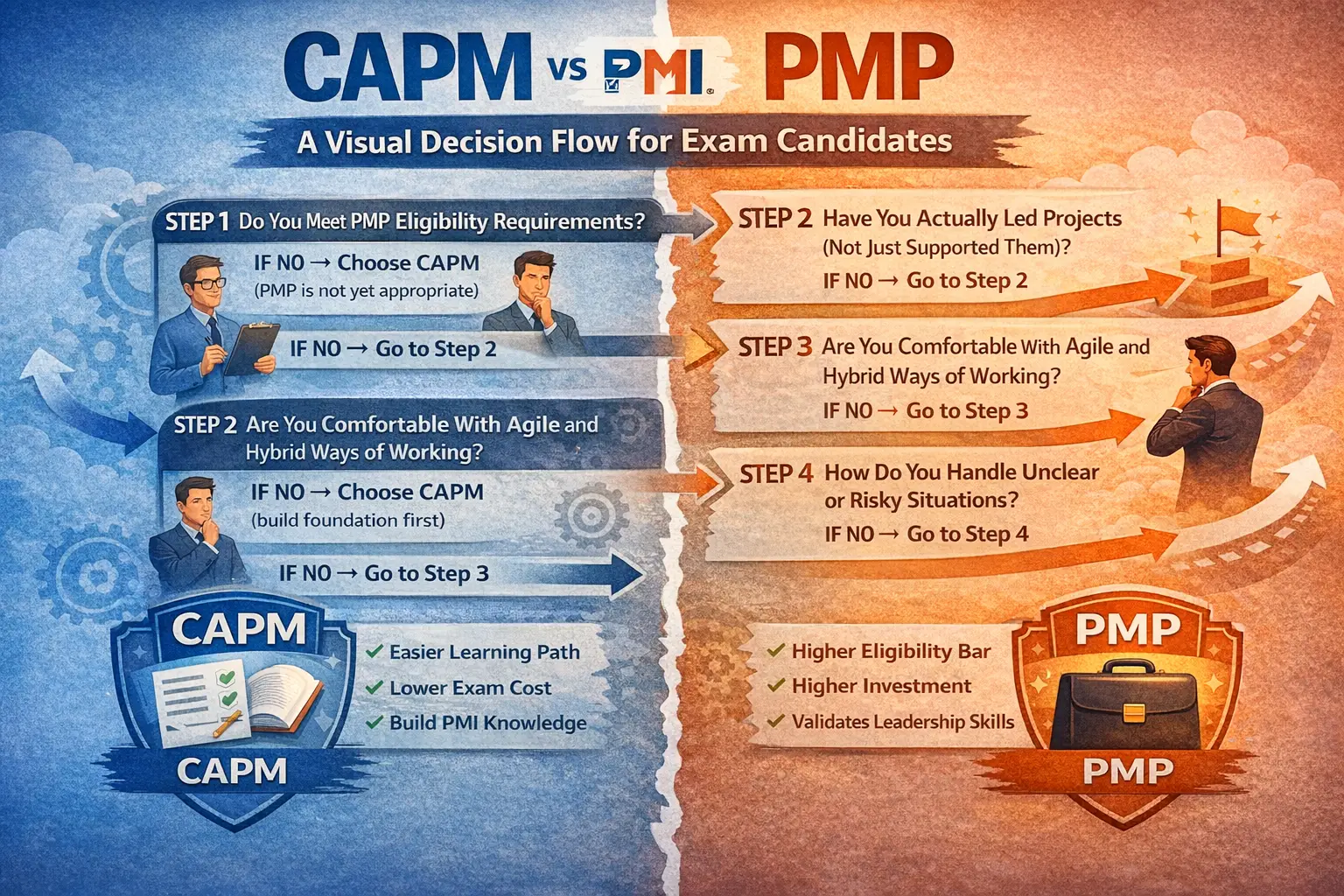
STEP 1: Do You Meet PMP Eligibility Requirements?
Ask yourself:
- Do I have a four-year degree and at least 4,500 hours of leading and applying project management experience in the last 8 years?
- OR do I have a secondary degree and at least 7,500 hours of leading and applying project management experience?
- Can I clearly describe this experience for a PMI audit?
IF NO → Choose CAPM (PMP is not yet appropriate)
IF YES → Go to Step 2
STEP 2: Have You Actually Led Projects (Not Just Supported Them)?
Ask yourself:
- Did I make project decisions?
- Did I manage stakeholders and resolve conflicts?
- Did I plan, monitor, and control work?
- Did people depend on my decisions?
IF NO → Choose CAPM (build foundation first)
IF YES → Go to Step 3
STEP 3: Are You Comfortable With Agile and Hybrid Ways of Working?
Ask yourself:
- Do I understand agile values and principles?
- Have I worked with iterative delivery, changing requirements, or cross-functional teams?
- Can I explain why agile is chosen over predictive in some cases?
IF NO → Choose CAPM (learn modern PMI approaches safely)
IF YES → Go to Step 4
STEP 4: How Do You Handle Unclear or Risky Situations?
Ask yourself:
- Am I comfortable making decisions with limited information?
- Can I choose the best action, not just a safe one?
- Do I focus on value, not just process?
IF NO → Choose CAPM (develop PMI mindset first)
IF YES → Go to Step 5
STEP 5: Can You Accept the Risk and Pressure of the PMP Exam?
Ask yourself:
- Am I ready for a long, scenario-based exam?
- Can I handle higher exam cost and retake risk?
- Am I prepared to study 200+ hours over several months?
IF NO → Choose CAPM (lower risk, strong preparation)
IF YES → Choose PMP
How to Interpret This Decision Flow
- Reaching CAPM at any step does not mean failure
- It means better timing and lower risk
- CAPM strengthens PMP readiness and confidence
- PMP should be attempted only when most answers are clearly “YES”
Common Patterns Seen in Successful Candidates
- CAPM → PMP later: Higher first-attempt PMP pass rates
- Direct PMP without readiness: More stress, more failures
- CAPM as preparation: Faster PMP study time later
This flow helps candidates choose the certification that prepares them, not the one that only looks impressive.
Eligibility Reality Check Most Candidates Ignore
Eligibility errors are one of the most common causes of stress and rejection.
CAPM Eligibility (Current PMI Requirements)
To apply for CAPM, you must have:
- A secondary degree (high school diploma or equivalent)
- 23 contact hours of project management education
There is no experience requirement. CAPM applications are rarely audited, and documentation is minimal.
PMP Eligibility (Updated and Precise)
PMP eligibility is strict and audit-driven.
You must meet one of the following:
Option 1:
- Four-year degree
- 4,500 hours of leading and applying project management experience
- Experience must be within the last 8 years
- 35 contact hours of project management education
Option 2:
- Secondary degree
- 7,500 hours of leading and applying project management experience
- Experience within the last 8 years
- 35 contact hours of education
What “Leading and Applying” Means
PMI expects evidence that you:
- Initiated projects
- Planned scope, schedule, cost, and risk
- Led teams and stakeholders
- Monitored progress and resolved issues
- Closed project phases or deliverables
Job titles do not matter. Hours must be verifiable. During an audit, PMI may contact supervisors or clients.
CAPM Exam Breakdown – Structure, Content, and Difficulty
Many candidates fail the CAPM exam not because it is too hard, but because they do not take it seriously enough. CAPM is often described online as an “easy” or “beginner” exam. This description creates false confidence. CAPM is not easy. It is broad, knowledge-heavy, and tests how well you understand PMI’s way of thinking.
If you prepare properly, CAPM is very manageable. If you underestimate it, failure is common.
CAPM Exam Structure: What to Expect on Exam Day
Before you start studying, you should clearly understand the exam format.
The CAPM exam has:
- 150 questions
- 3 hours to complete the exam
- Multiple-choice questions only
- No negative marking (you are not penalized for wrong answers)
This means you should answer every question, even if you are not fully sure.
The time pressure is real. You have about 72 seconds per question. Candidates who do not practice time management often run out of time in the last section of the exam.
CAPM Content Focus: What the Exam Actually Tests
CAPM reflects PMI’s modern project management framework, not just traditional methods. This is important because many candidates still study only old predictive content.
The exam covers:
Predictive Methods
You must understand:
- Project life cycles
- Planning concepts (scope, schedule, cost)
- Risk and quality basics
- Change control and governance
You are not expected to calculate complex formulas, but you must understand why these processes exist.
Agile Practices
Agile is a major part of CAPM.
You must understand:
- Agile values and principles
- Iterative and incremental delivery
- Roles like product owner and scrum master
- Team collaboration and servant leadership
Many candidates fail CAPM because they ignore agile or treat it as a small topic. This is a serious mistake.
Hybrid Approaches
Hybrid means using predictive and agile together.
You should understand:
- When hybrid is useful
- Why organizations mix approaches
- How teams adapt to change
Business Analysis Fundamentals
CAPM also includes basic business analysis concepts, such as:
- Requirements gathering
- Stakeholder needs
- Value-focused thinking
Project Roles and Governance
You must understand:
- Who makes decisions in a project
- Differences between sponsor, manager, and team
- Governance structures and reporting
Why CAPM Is Knowledge-Heavy (Not Experience-Heavy)
CAPM does not test how you managed a real project. It tests:
- How well you understand concepts
- How accurately you use PMI terms
- Whether you can recognize correct practices
This is why memorizing without understanding does not work. PMI often uses similar answer choices, and only one is fully correct.
Why Candidates Fail the CAPM Exam
Common reasons for failure include:
- Assuming the exam is easy and studying lightly
- Memorizing definitions without understanding meaning
- Ignoring agile concepts or studying only predictive methods
- Not practicing time management
- Using outdated study materials
Most CAPM failures are avoidable with the right preparation approach.
CAPM Preparation Expectations: What You Really Need
Most successful candidates prepare with:
- 6 to 10 weeks of study
- 80 to 120 total study hours
- Regular practice exams to build speed and confidence
You should focus on:
- Understanding concepts, not just remembering words
- Practicing mixed question sets
- Reviewing why answers are wrong
CAPM preparation builds PMI language and mindset, which makes future PMP study much easier.
PMP Exam Breakdown – What the Exam Really Tests
The PMP exam is very different from CAPM. PMP is not a technical or memorization exam. It is a situational judgment exam. PMI wants to know how you think, not how much you remember.
Many experienced professionals fail PMP because they approach it like a traditional test.
PMP Exam Structure: What You Will Face
The PMP exam includes:
- 180 questions
- 230 minutes
- Different question types:
- Multiple choice
- Multiple response
- Matching
- Drag-and-drop
- Adaptive branching, where question difficulty adjusts based on performance
- The PMP exam cost varies for members and non-members of PMI.
This means focus and consistency matter more than speed alone.
PMP Content Distribution
PMP certification exam questions are grouped into three domains:
- People – about 42%
- Team leadership
- Conflict resolution
- Communication
- Motivation
Study with realistic questions of domain 1 to thoroughly cover this domain.
- Process – about 50%
- Planning and execution
- Risk and quality
- Monitoring and control
- Change management
It’s the most important domain and needs thorough preparation via updated and relevant PMP test questions of domain 2.
- Business Environment – about 8%
- Compliance
- Benefits realization
- Organizational strategy
Check out realistic pmp certification practice questions for domain 3 to cover this domain quickly and efficiently.
Across all domains:
- About 50% agile or hybrid
- About 50% predictive
Ignoring agile is one of the fastest ways to fail PMP.
What the PMP Exam Really Tests
PMP tests your ability to:
- Lead people, not control them
- Resolve conflict professionally
- Communicate with stakeholders
- Focus on business value
- Make ethical decisions
- Apply an agile mindset when needed
You are often asked:
- What should the project manager do next?
- What is the best action?
- How can value be protected?
Tools PMP Still Tests (But in a Different Way)
PMP still includes tools such as:
- Earned Value Management (EVM)
- Risk response strategies
- Scheduling concepts
However, these are not tested as formulas. They appear inside scenarios. You must understand:
- When to use a tool
- Why it matters
- What action it supports
Knowing formulas without understanding context will not help.
Key Message for Exam Candidates
- CAPM tests what you know
- PMP tests how you think
Understanding this difference helps you:
- Choose the right exam
- Study the right way
- Avoid costly mistakes
Exam Readiness Comparison – Risk vs Reward
Confused about what to choose? CAPM or PMP. Below is the detailed break down that will help you understand the ROI of both PMI certifications.
CAPM Readiness Profile
- Clear syllabus
- Lower emotional pressure
- Predictable questions
- Lower financial risk
- Pass rates often 80%+
PMP Readiness Profile
- Ambiguous scenarios
- Familiarity with examples of PMP application
- High mental pressure
- Expensive retakes
- Heavy mindset shift
- Estimated pass rates 60–70%
Choosing PMP too early is one of the biggest career mistakes candidates make.
PMP or CAPM: Career Impact and Salary Reality
1. Salary Differences Between CAPM and PMP
According to the PMI Salary Survey (2024):
- PMP median salary: $120,000+ USD globally
- CAPM median salary: ~$80,000 USD
These figures highlight the long-term financial value of PMP. However, they are averages, and actual salaries can vary based on other factors.
2. Factors That Influence Salary
Salary outcomes depend on:
- Job role – Project Manager, Program Manager, or Coordinator roles pay differently.
- Region – Salaries in North America or Western Europe are generally higher than in other regions.
- Industry – IT, consulting, and construction often pay more for PMP-certified professionals.
- Experience level – More experienced candidates see higher salary benefits.
It is important to note that simply having a PMP certificate does not automatically guarantee a higher salary or promotion. Employers look for demonstrated leadership and decision-making skills.
3. The Risk of Attempting PMP Too Early
Taking the PMP exam without sufficient readiness can:
- Reduce your confidence if failed
- Delay career progression
- Increase financial and time costs
This is why many professionals benefit from CAPM first, especially if they are early in their careers or have limited project leadership experience.
4. CAPM vs PMP: Career Growth Path
- CAPM:
- Improves employability at early career stages
- Helps candidates enter project roles or coordination positions
- Builds PMI terminology and mindset
- PMP:
- Unlocks senior leadership roles and higher responsibility
- Accesses program and portfolio management positions
- Demonstrates capability to lead complex, high-value projects
Choosing the right certification at the right time ensures steady and sustainable career growth, rather than rushing into a certification for immediate financial gain.
Cost, ROI, Long-Term Commitment of CAPM and PMP
CAPM Costs
- Lower exam fee
- Lower prep cost
- Easier maintenance
PMP Costs
- High exam fee
- Expensive training
- Retake cost
- 60 PDUs every 3 years for renewal
ROI Truth
A failed PMP costs more than a delayed PMP.
CAPM as a Strategic Path Toward PMP
CAPM preparation helps PMP by:
- Teaching PMI language
- Reducing PMBOK shock
- Improving application confidence
- Lowering PMP failure risk
CAPM education hours count toward PMP education requirements.
Essential Preparation Resources for CAPM and PMP Candidates
Proper preparation is the key to success for both CAPM and PMP exams. Using official PMI resources, structured study plans, and practice tools significantly increases your chances of passing on the first attempt. Ignoring these resources is one of the most common reasons candidates fail.
1. CAPM Preparation Resources
CAPM focuses on foundational knowledge, so preparation should emphasize understanding concepts, terminology, and basic frameworks. Here are the most important resources:
-
PMP Exam Content Outline (ECO):
Even for CAPM, reviewing the content outline helps you understand what PMI expects. CAPM covers knowledge areas, process groups, and agile fundamentals.
-
PMBOK Guide – 7th Edition:
The 7th edition emphasizes principles, performance domains, and value delivery. CAPM candidates should focus on:
- Project life cycles (predictive, agile, hybrid)
- Roles, responsibilities, and governance
- Key processes and terminology
-
Agile Practice Guide:
Agile is now a required topic even for CAPM. Study:
- Agile principles and values
- Iterative delivery methods
- Team roles and collaboration
-
Practice Exams and Simulators:
CAPM requires speed and accuracy. Use:
- Online multiple-choice question sets
- Timed mock exams
- Explanations for wrong answers to reinforce understanding
-
PMI Membership:
A membership provides discounts on exams and access to official articles, webinars, and study materials. It also gives access to the PMI digital library, which is very helpful for beginners.
-
Visual Learning Tools:
Tools like flowcharts, mind maps, or Vargas-style diagrams help you visualize processes, knowledge areas, and relationships between tasks. This makes memorization easier and more meaningful.
CAPM Preparation Tip:
Focus on understanding concepts deeply, not just memorizing definitions. Most CAPM questions are scenario-based in a simple form, and your ability to recognize correct PMI practices is what matters most.
2. PMP Preparation Resources
PMP requires higher-level preparation because it tests situational judgment, leadership, and decision-making. Candidates need to combine knowledge, experience, and strategy.
Get 250+ PMP Questions and Answers With Explanation in PDF
-
PMP Exam Content Outline (Post-2021 ECO):
This is your primary PMP study plan. It defines:
- Domains: People (42%), Process (50%), Business Environment (8%)
- Task descriptions for each domain
- Percentage of agile/hybrid vs predictive questions
-
PMBOK Guide – 7th Edition:
PMP candidates must understand performance domains and principles. Key focus areas:
- Value delivery and project outcomes
- Governance and compliance
- Integration of predictive, agile, and hybrid approaches
-
Agile Practice Guide:
Agile and hybrid approaches make up roughly 50% of the PMP exam. Study:
- Agile project planning, iterative delivery, and continuous improvement
- Servant leadership, team motivation, and collaboration strategies
- Hybrid integration points with predictive methods
-
Practice Simulators and Mindset-Based Tools:
PMP is scenario-heavy. Use:
- Realistic PMP questions sets with real exam logic
- Situational judgment practice
- Explanation of why an answer is the “best” choice, not just correct
-
Visual Frameworks:
Vargas-style flowcharts, process diagrams, and knowledge area maps are extremely useful. They help connect tools, techniques, and domains, making scenario analysis faster during the exam.
-
PMI Membership and Official Resources:
Membership offers:
- Discounted exam fees
- Access to webinars and PMI standards
- PMI’s digital library with case studies and reference guides
-
Additional Tools for PMP Candidates:
-
- Flashcards for domain tasks and key formulas
- Study groups or forums for peer discussion
- Risk and earned value calculation practice (for scenario-based questions)
PMP Preparation Tip:
- Plan for 3–6 months of study with 200+ hours for most candidates
- Follow a structured study plan, combine cheat sheet, exam questions, and scenario analysis
- Focus on thinking like a PMI project manager, not memorizing formulas
Common Mistakes Candidates Make
- Applying for PMP too early
- Ignoring audit risk
- Memorizing instead of thinking
- Studying only PMBOK
- Believing salary hype
Final Thoughts: Making the Right Certification Decision
There is no shortcut in PMI certifications. The correct choice between CAPM or PMP is not about speed or prestige. It is about timing, readiness, and risk management. Candidates who respect the certification path pass faster, spend less, and build stronger careers.
The smartest professionals choose the certification that prepares them, not the one that intimidates them.