


FINRA Series 63 Pass Rate (2026): Why Candidates Fail and How to Pass First Time
Table of Contents
- Why Do 15–20% of FINRA Series 63 Exam Candidates Fail?
- How You Can Make Sure You’re in the 80–85% Who Pass
- Quick Comparison: Why People Fail vs How You Can Pass the Series 63 Exam
- Failing Isn’t the End: How to Reach the Series 63 Pass Rate
- Conclusion
Introduction:
The FINRA Series 63 pass rate is around 80% to 85%. FINRA doesn’t officially publish exact numbers, but this range is a widely accepted industry estimate.
This means most people pass the exam on their first try. That sounds good, right?
Study with free Series 63 exam practice questions
But here is the real question: if the exam is “easy,” why do 15% to 20% of people still fail every year?
In this article, you will learn what the Series 63 exam pass rate really means, why people fail, and how you can make sure you are in the group that passes, not the group that fails.
Let’s break it down why 15% to 20% of candidates fail the Series 63 exam.
| Exam Feature | Specification |
| Estimated Pass Rate | 80% – 85% |
| Passing Score | 70 |
| Total Questions | 60 |
| Time Limit | 75 minutes |
| Exam Cost | $147 |
Why Do 15–20% of FINRA Series 63 Exam Candidates Fail?
This is the most important question in the whole article.
The Series 63 exam is not designed to trick smart people. It is designed to test careful understanding. Most people who fail are capable of passing. They fail because they make the same mistakes again and again.
Let’s look at these mistakes in detail.
1. They Underestimate the Exam
Many candidates think the Series 63 is “easy” before they even open the book.
They say things like:
- “It’s only 60 questions.”
- “The Series 7 was harder.”
- “I can study for this in a few days.”
This thinking is dangerous.
Why this Causes Failure
Because the exam is short, people:
- Study too fast
- Skip difficult topics
- Do not review mistakes
- Do not take full practice exams
They believe basic reading is enough.
But the Series 63 is not about volume. It is about precision.
The real problem: small details matter
On the Series 63:
- One word can change the answer
- One condition can change the rule
- One exception can reverse the result
For example:
-
- “Must register” vs “may register”
- “Exempt security” vs “exempt transaction”
- “State administrator may” vs “must”
If you rush, you miss these differences. Many people fail by one or two questions. Underestimating the exam is often the reason.
2. They Memorize Instead of Practicing
This is one of the biggest mistakes. Some candidates:
- Read the textbook many times
- Highlight almost every page
- Take long notes
They feel busy. They feel productive. But they are not preparing the right way.
Why memorization does not work for Series 63
The Series 63 exam rarely asks:
- “What is the definition of X?”
- “What rule says Y?”
Instead, it asks:
- “What should the agent do in this situation?”
- “Which action is allowed or not allowed?”
- “Who has authority in this case?”
That means you must apply the rule, not repeat it.
What happens on exam day
Candidates who only read:
- Feel confident before the exam
- Recognize topics but not answers
- Narrow choices to two answers
- Guess the final answer
This leads to many wrong answers.
Practice questions solve this problem because they:
- Show how rules appear in real questions
- Teach common wording patterns
- Force you to make decisions
Without practice, you are learning theory. The exam tests action.
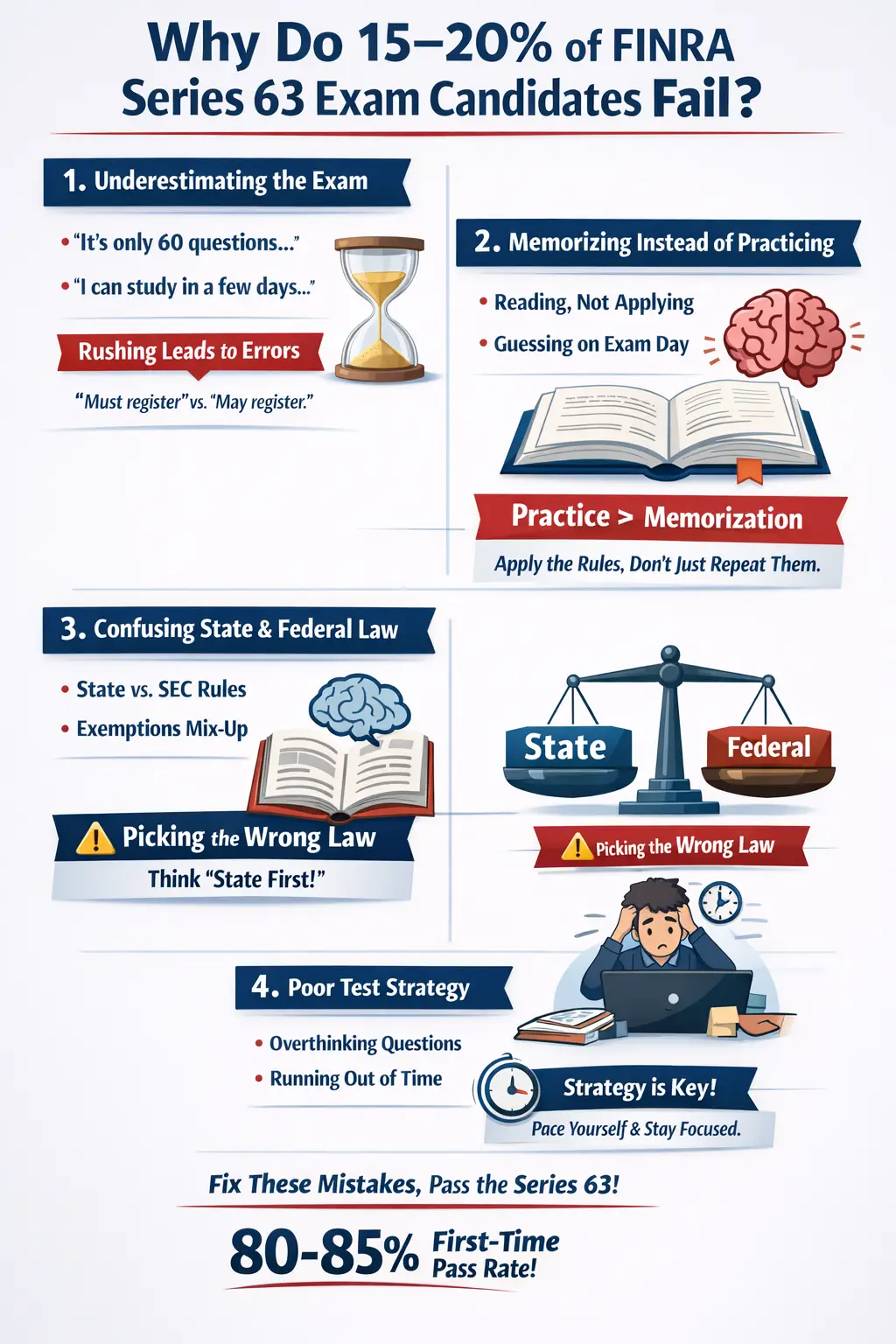
3. They Confuse State Law and Federal Law
This is one of the top reasons people fail the Series 63, even strong candidates. The Series 63 focuses on state securities law. But many candidates study for other exams first, like:
- Series 7
- Series 65
- Series 66
Those exams include federal law and SEC rules. If you are not sure which exam is right for you. Check out our Series 63 vs 66 detailed comparison guide to make the right decision for your career.
Where the confusion happens
Candidates often mix up:
- SEC rules and state rules
- Federal exemptions and state exemptions
- SEC authority and state administrator authority
On the exam, this leads to choosing answers that are true, but not true at the state level.
Common examples of confusion
Candidates struggle with questions like:
- Who must register with the state?
- Which securities are exempt under state law?
- What actions can a state administrator take?
- Can the administrator deny, suspend, or revoke registration?
If you answer using federal rules, you often pick the wrong choice.
Why this Mistake is Costly
The exam does not forgive confusion.
You can:
- Understand the topic
- Remember the rule
- Still fail the question
Why? Because the exam asks, “What does the state law say?”
Practice questions help because they train your brain to think:
“State law first. Federal law second.”
4. They Lack Exam Strategy
Some candidates know the material well. They still fail. This happens because they do not know how to take the exam.
Common Exam-Day Mistakes
These candidates often:
- Read too fast
- Overthink simple questions
- Change answers without a clear reason
- Spend too much time on one question
- Rush at the end
The Series 63 exam is short, but time pressure still matters.
Overthinking is a Big Problem
Many questions are actually simple.
But candidates:
- Look for tricks that are not there
- Add facts that are not in the question
- Talk themselves out of the correct answer
This usually happens when someone has not practiced enough.
Why Practice Questions Fix This
Series 63 practice questions:
- Teach pacing
- Build confidence
- Reduce second-guessing
- Train you to spot key words
When you practice, your brain learns patterns. On exam day, you recognize them faster and stay calm.
Techcertguide has published free Series 63 questions. Study with them to get ready for your final exam without spending a dollar.
The Big Picture: Why These Mistakes Lead to Failure
None of these mistakes mean a person is not smart.
They mean the person:
- Prepared the wrong way
- Focused on reading instead of doing
- Did not train for exam-style thinking
The Series 63 rewards:
- Careful reading
- Clear understanding
- Repeated practice
When candidates change how they prepare, most of them pass.
That is why the pass rate is high, and why the people who fail usually fail for fixable reasons, not ability.
First-Time Pass Rate of Series 63 Exam: What You Need to Know
The Series 63 exam has an overall pass rate of 80–85%. Most candidates pass eventually, but first-time success depends on preparation. About 80–85% of candidates also pass on their first try if they study the right way.
How You Can Make Sure You’re in the 80–85% Who Pass
Here is the good news. Passing the Series 63 is not about luck. It is not about talent. It is about preparation choices. Most people who fail do not fail because they cannot understand the material. They fail because they prepare in a way that does not match how the exam works. When candidates change that, results change fast.
The most effective change is simple: use practice questions early and often.
Reading vs Practice: Why Both Matter (But Not Equally)
Reading is where preparation begins. It introduces the rules, the terms, and the structure of state securities law. Without reading, practice questions feel confusing and frustrating. But reading alone stops helping very quickly.
The Series 63 exam does not reward people who recognize words. It rewards people who can choose the correct action in a situation. Practice questions help bridge that gap. They turn information into decisions and hit the Series 63 pass rate.
For example, a candidate reads that “certain securities are exempt from registration.” That sounds clear. But on the exam, the question asks whether a specific transaction is exempt, not the security itself. A reader freezes. A practitioner recognizes the difference right away.
Reading Is Learning the Map
Reading is like studying a map before a trip. You know the roads exist. You understand where things are located. But you have not driven yet.
In the same way, reading helps you recognize topics on the exam. You may say, “I remember this chapter.” But recognition is not the same as readiness.
For example, a candidate reads about the state administrator’s powers. On the exam, they remember the topic but cannot decide whether the administrator may or must take action. The map was learned. The road was never driven.
Practice Is Driving the Road
Practice questions are where learning becomes real. They force you to slow down, read carefully, and make choices. They show you how rules appear in exam language, not textbook language.
Each question is a short drive. Over time, driving feels natural.
Mini example:
A practice question asks whether an agent must register in a certain state. At first, the candidate gets it wrong. After reviewing the explanation, the rule sticks. When a similar question appears on the exam, the answer feels familiar.
How Practice Questions Train You to Read Questions Correctly
The Series 63 exam uses simple words, but the meaning often hides in small details. Many candidates fail not because they do not know the rule, but because they read too fast.
Practice questions train you to slow down and read with purpose.
Example:
A question says, “Which of the following is NOT required?” A rushed reader misses the word “not” and chooses the most correct-sounding answer. A practiced reader spots the word immediately and avoids the trap.
Understanding What the Exam Is Really Asking
Many exam questions look long, but they usually test one idea. Practice teaches you how to strip the question down to its core. You stop feeling overwhelmed and start feeling in control.
For example:
A long question describes a client, a product, and a transaction. A new candidate panics. A practiced candidate asks one simple question: “Is this about registration or exemption?” The answer becomes clear.
How Practice Questions Help You Avoid Common Traps
Wrong answers on the Series 63 are often almost right. They may be correct under federal law or correct in a different situation. That is what makes them dangerous.
Practice questions expose these traps early, when mistakes are safe.
Mini example:
An answer choice describes an SEC rule that sounds correct. A candidate who practiced state-law questions knows to pause and ask, “Does this apply at the state level?” Without practice, that pause never happens.
Learning the Difference Between “Almost Right” and “Correct”
The Series 63 does not reward “close enough.” It rewards the best answer for that exact situation. Practice teaches this difference clearly.
For instance, two answers both sound reasonable. One protects the client more. Practice trains you to choose the answer that best fits state law and investor protection, not the one that just sounds nice.
Learning From Mistakes Before They Cost You Points
Mistakes during practice are useful. They show you exactly where your understanding is weak. Fixing that weakness before exam day is one of the biggest advantages you can have.
For example, a candidate keeps missing questions about exempt transactions. After reviewing explanations, they realize they confuse transactions with securities. That mistake disappears before the exam ever begins.
Turning Wrong Answers Into Stronger Understanding
Each wrong answer is a lesson. When you review it, you are less likely to make the same mistake again. Over time, errors decrease and confidence grows.
For example:
The first time, a candidate guesses. The second time, they remember the explanation. The third time, they answer with confidence. That is how learning sticks.
How Practice Builds Confidence and Controls Exam Stress
Stress often comes from the unknown. Practice removes the unknown. When the exam feels familiar, anxiety drops.
Candidates who practice know what to expect. That calm improves accuracy.
For example:
A candidate who took several timed practice exams knows they have enough time. On exam day, they do not rush. They read carefully. They finish with minutes to spare.
From Uncertainty to Control on Exam Day
Practice changes how the exam feels. Instead of reacting, you respond. Instead of guessing, you decide.
Mini example:
A difficult question appears. A new candidate panics. A practiced candidate flags it, moves on, and returns later with a clear head.
From Guessing to Knowing You Are Ready
At the start, many candidates guess and hope. With practice, hope turns into understanding. Understanding turns into confidence.
That shift is powerful.
Mini example:
Before practice: “I think this is right.”
After practice: “I know why this is right.”
That is how candidates move into the batch of applicants who achieve the Series 63 pass rate of 80–85%.
Quick Comparison: Why People Fail vs How You Can Pass the Series 63 Exam
| Reason | Why People Fail | How You Can Pass |
| Underestimating the Exam | Think it’s easy; study too fast; skip practice | Take time, read carefully, do full practice exams |
| Memorizing Instead of Practicing | Read textbooks repeatedly; highlight pages; don’t apply rules | Do many practice questions; apply rules to scenarios |
| Mixing State and Federal Law | Confuse SEC rules with state rules; choose answers based on federal law | Focus on state law first; practice questions that test state-specific rules |
| Poor Exam Strategy | Overthink, second-guess, rush, run out of time | Practice pacing; flag questions; stick to one answer unless confident |
| Missing Small Details | Skip small words like “must,” “may,” or “not”; ignore exceptions | Read every word carefully; practice spotting key words |
| Lack of Confidence | Panic, guess, or feel unsure | Build confidence with practice; simulate timed exams; learn from mistakes |
| Not Learning From Mistakes | Repeat same errors during practice or study | Review wrong answers carefully; understand why; avoid repeating them |
Failing Isn’t the End: How to Reach the Series 63 Pass Rate
Failing the Series 63 exam can feel disappointing. It is normal to feel frustrated or worried. But one failure does not mean you cannot pass. In fact, many candidates pass on their second or even third try. Understanding the pass rate of Series 63 exam and what went wrong can help you turn a setback into a success.
Tips to Help you Achieve Series 63 Pass Rate on Second Attempt
Step 1: Review Your Weak Areas Carefully
The first step after failing is to figure out exactly where you struggled. Don’t just assume you know what you got wrong. Look at your score report or notes. Identify which topics caused the most trouble.
For example, some candidates miss questions about exemptions, registration rules, or prohibited practices. Others may struggle with understanding what the state administrator can and cannot do. Write down the topics you find hardest. Then plan to study those first.
If you miss three questions about “exempt transactions,” go back to the textbook and practice questions on that topic until you feel confident.
Step 2: Do More Practice Questions
Reading alone is not enough. The Series 63 exam pass rate shows that candidates who practice questions are much more likely to pass. Practice questions help you apply the rules, understand tricky wording, and build confidence.
Start by doing questions in the areas where you struggled. Review the explanations carefully. Don’t just look at the correct answer, understand why other answers were wrong.
For example, if a practice question asks, “Which security is exempt under state law?” and you pick the wrong answer, read the explanation fully. Check what you missed. Then try a few more questions on the same topic.
Step 3: Slow Down and Focus
Many candidates fail because they rush. The exam has only 60 questions and 75 minutes, but rushing increases mistakes. After failing once, it is important to slow down during both study and practice exams.
Take your time to read each question carefully. Look for small words like “must,” “may,” “not,” or “exempt.” These words often decide the correct answer.
One question may say, “Which of the following is NOT required?” Missing the word “NOT” can make a correct answer wrong. Practicing carefully helps you spot these small details.
Step 4: Change How You Study
Most people who pass after failing do so because they change their study method. If you only read textbooks the first time, add more practice questions. If you guessed too much before, focus on understanding each rule.
Make a clear plan for your second attempt. Include:
- Targeted review of weak areas
- Timed practice exams
- Tracking mistakes and learning from them
Let’s understand with an example. A candidate who failed may schedule 30 minutes daily for targeted practice questions, plus one full-length timed practice exam each week. This focused approach improves understanding and confidence.
Step 5: Treat Failure as Feedback
Finally, remember that failing is not punishment. It is information. It tells you what you need to improve. Use it wisely. Review your mistakes, change your method, practice, and slow down.
Many candidates pass on their second try. By learning from your first experience, you can increase your chances of joining those who achieved the Series 63 pass rate. The pass rate is high, but your preparation determines if you are part of that success.
Conclusion
Here’s the truth: the Series 63 pass rate is high, about 80-85%. Most people pass. But the ones who fail? They don’t fail because they aren’t smart. They fail because they study the wrong way, rush, or skip practice.
You can join the passers by doing a few simple things differently. Focus on your weak areas. Practice with Series 63 exam questions until the patterns feel natural. Slow down. Read each word. Know state law first. Treat mistakes as lessons, not failures.
Practice builds more than knowledge. It builds confidence and calm. When exam day comes, you don’t hope you’re ready. You know you’re ready.
Fail once? No problem. Learn, adjust, and go again. That’s how you move from uncertainty to success and claim your spot in the pass rate of Series 63 exam.