


Confused About PMP vs MBA? Here’s How to Choose the Best for You
Choosing the next step in your career can feel confusing and stressful. You may be asking yourself: Should I invest months and money in a PMP certification, or spend years pursuing an MBA? The question of PMP vs MBA is a common dilemma for professionals who want faster promotions, higher pay, or leadership opportunities, but making the wrong choice can cost time, money, and career growth.
This blog will break down the key differences between the PMP and MBA debate, covering skills, career outcomes, costs, and time commitments. By the end, you’ll have a clear, practical roadmap to decide which path aligns best with your goals, industry, and personal situation.
PMP vs MBA: What They Really Are and How They Shape Your Career
What is PMP?
PMP stands for Project Management Professional, and it is one of the most recognized certifications in the world for project managers. It is offered by the Project Management Institute (PMI), which is a global organization that sets standards for project management.
The main goal of PMP is to show that you know how to plan, execute, monitor, and close projects successfully. A project could be anything from building a software system, constructing a building, launching a marketing campaign, or implementing a new process at work. If you have PMP certification, employers know that you can manage projects effectively and handle challenges that come up along the way.
Focus Areas of PMP:
- Initiating and Planning Projects: Creating project plans, defining goals, and estimating time and costs.
- Executing Projects: Leading teams, managing resources, and keeping the project on track.
- Monitoring and Controlling: Tracking progress, managing risks, and solving problems before they grow.
- Closing Projects: Delivering results, gathering feedback, and documenting lessons learned.
Eligibility Requirements:
To apply for PMP, you usually need:
- A bachelor’s degree (or equivalent) plus at least 3 years of project experience with 4,500 hours leading projects, or
- A high school diploma with 5 years of project experience and 7,500 hours of leading projects.
Exam: The PMP exam has 180 multiple-choice questions. It tests your knowledge of project management concepts, processes, and real-world scenarios.
Benefits of PMP:
- Boosts credibility and trust with employers and clients.
- Opens doors to higher-paying roles in project management.
- Helps you develop practical, hands-on skills that you can apply immediately at work.
- Recognized in many industries like IT, construction, healthcare, finance, and engineering.
Many professionals choose PMP because it focuses purely on projects. It is shorter and less expensive than an MBA and gives a direct boost to project management careers.
What is an MBA?
MBA stands for Master of Business Administration. Unlike PMP, which is a certification, an MBA is a graduate-level degree that teaches you about all aspects of business. It is ideal for people who want to move into leadership or management roles.
Duration and Structure:
- Full-time MBA programs usually take 1–2 years.
- Part-time programs can take 2–3 years while you continue working.
- Courses include lectures, group projects, case studies, and sometimes internships.
Specializations:
Many MBA programs allow you to focus on a specific field. Examples include:
- Finance – Managing investments, budgets, and financial strategy.
- Marketing – Understanding customer behavior and promoting products.
- Human Resources (HR) – Managing teams, hiring, and employee development.
- Entrepreneurship – Learning how to start and grow a business.
- Operations – Improving processes and supply chains.
Goal of an MBA:
The main purpose of an MBA is to prepare you for leadership roles. Unlike PMP, which focuses on projects, MBA teaches you strategy, decision-making, and managing people.
It gives a big-picture view of business and prepares you to handle responsibilities at higher levels, such as a manager, director, or even CEO.
Benefits of an MBA:
- Broader Knowledge: You learn about all parts of a business, not just projects.
- Networking: MBA programs connect you with classmates, alumni, professors, and industry professionals. These connections can help you find better job opportunities.
- Career Flexibility: MBA graduates can work in many roles, from marketing and finance to operations and leadership positions.
- Higher Salary Potential: Many MBA graduates see significant salary increases after completing their degree.
Unlike PMP, an MBA requires a larger investment of time and money, but it can open doors to senior leadership positions and give you skills that last a lifetime.
Key Differences Between PMP and MBA in 2026
Understanding the main differences between PMP and MBA is important. It helps you make a clear decision and avoid wasting time or money. Let’s dive deeper into four major areas: scope & focus, time & effort, cost, and recognition & credibility.
Also read: What’s the difference between CAPM and PMP?
1. Scope & Focus
The scope and focus of PMP and MBA are very different.
- PMP
The PMP certification focuses narrowly on project management. It teaches you how to plan, execute, monitor, and close projects successfully. You learn practical tools and techniques, such as scheduling, budgeting, risk management, and team communication.
PMP is very hands-on. It is not about running an entire business but about making projects work efficiently. If your daily work involves managing deadlines, resources, and project teams, PMP gives you the exact skills you need.
- MBA
An MBA is much broader. It covers all aspects of business and leadership, including finance, marketing, strategy, human resources, operations, and entrepreneurship. While you do not focus only on projects, you learn how a business operates as a whole.
You also develop strategic thinking, leadership, and decision-making skills. An MBA prepares you for senior roles like department head, director, or CEO. It is less about day-to-day tasks and more about long-term growth and management.
Example: If you are an IT project manager, PMP will teach you to complete projects efficiently. An MBA will teach you how to manage the IT department or company strategy, beyond just projects.
2. Time & Effort
Time and effort are another big difference between the two paths.
- PMP
Preparing for PMP usually takes 3–6 months of focused study, depending on your experience. You must review project management concepts, understand the PMBOK Guide, and practice exam questions.
The PMP preparation is intensive but short-term. After passing the exam, you maintain your certification through continuing education hours, which is manageable.
- MBA
An MBA is a long-term commitment. A full-time MBA usually takes 1–2 years, while part-time or online programs can take 2–3 years. You attend classes, complete assignments, participate in group projects, and sometimes do internships.
The workload is consistent and significant. You also have exams in many subjects and may need to submit a final thesis or capstone project.
Insight: If you want quick results and can’t take years off, PMP is more practical. If you can invest multiple years and want broad knowledge, an MBA may be the right choice.
3. Cost Comparison
The cost difference is huge and affects many people’s decisions.
- PMP
The exam fee for non-members is around $575. If you are a PMI member, it’s cheaper, about $405. You may also pay for training courses, which can range from $500 to $2,000 depending on the provider.
Overall, the total cost is moderate and usually much lower than an MBA.
- MBA:
The cost of an MBA can vary widely. Tuition can range from $20,000 to over $100,000, depending on the school and country. You also need to consider living expenses, travel, books, and other fees. Some programs also require you to pause your job, which adds an opportunity cost, the money you could have earned during that time.
Example: A PMP might cost you around $1,000 including training. A top MBA could cost $70,000 in tuition plus living expenses. That’s a big difference.
Practical tip: If you are on a limited budget or want a faster return on investment, PMP is more economical. MBA is a bigger financial and time investment but can lead to higher long-term earnings.
4. Recognition & Credibility
How the world sees PMP and MBA also differs.
- PMP
PMP is recognized globally within the project management field. It signals to employers that you know project management best practices and can deliver results.
PMP certification is highly respected in IT, construction, engineering, and healthcare. Many companies even require it for project management roles.
- MBA
An MBA is recognized worldwide for general management skills. Employers see an MBA as proof that you can lead teams, understand strategy, and make business decisions. An MBA opens doors to leadership, executive, and entrepreneurial roles across industries.
Insight: PMP gives you credibility for project-focused roles. MBA gives you credibility for leadership and strategy roles. Your choice should match your career goals and the type of recognition you need.
Additional Considerations
-
Learning Style:
-
-
- PMP is mostly self-study with guided courses. You focus on practical applications.
- MBA involves interactive learning, group projects, and discussions. It develops soft skills like communication and teamwork.
- PMP is mostly self-study with guided courses. You focus on practical applications.
-
-
Industry Relevance:
-
-
- PMP is valued more in project-driven industries like IT, construction, and engineering.
- MBA is more versatile and can help you move across different sectors or into leadership roles.
- PMP is valued more in project-driven industries like IT, construction, and engineering.
-
-
Career Flexibility:
-
- PMP can enhance your current career path and help you get promotions in project management.
- MBA allows you to change careers or take bigger leadership responsibilities.
- PMP can enhance your current career path and help you get promotions in project management.
High-Paying Jobs and Growth Paths: MBA vs PMP
When deciding between a PMP certification and an MBA, understanding how each impacts your career is one of the most important factors. Let’s explore the jobs, industries, salary expectations, and long-term growth in more detail.
Jobs and Industries for PMP
PMP certification is focused on project management, which is in demand across many industries. Here are some typical roles you can pursue:
- Project Manager: You lead projects from start to finish. You plan, manage resources, track timelines, and make sure the project meets its goals. Companies rely on you to keep everything on track.
- Program Manager: This role is bigger than a project manager. You oversee multiple projects that are connected, ensuring they all align with the organization’s strategy.
- Operations Manager: Some PMP holders move into operations, using project management skills to improve efficiency and processes across teams.
Industries where PMP is highly valued:
- Information Technology (IT): Software development, IT infrastructure, cloud services.
- Construction: Large building projects, engineering works, infrastructure development.
- Healthcare: Hospital management, clinical programs, healthcare IT projects.
- Finance: Banking operations, compliance, and risk management projects.
- Engineering: Manufacturing, product development, and industrial projects.
PMP certification shows that you understand the processes, risks, and best practices of project management. Employers see certified professionals as more reliable and capable of delivering results on time and within budget. This trust can lead to promotions faster than non-certified peers, especially in project-driven companies.
Additionally, PMP certification can make you more competitive for global roles. Many multinational companies require project managers to have PMP credentials for international projects. This is a big advantage if you want to work abroad or in a multinational environment.
Jobs and Industries for MBA
An MBA offers a broader range of career opportunities, often moving beyond specialized project management roles into business leadership and strategic positions. Common roles include:
- Business Analyst: You study business processes, identify problems, and recommend solutions. MBAs are trained to think strategically about business efficiency.
- Marketing Manager: Lead marketing campaigns, branding strategies, and customer engagement plans. MBA programs teach skills in digital marketing, analytics, and brand management.
- Product Manager: Oversee the lifecycle of a product from planning and design to launch. MBA graduates combine strategy, market understanding, and leadership skills in this role.
- CEO or Senior Leadership Roles: MBAs are often groomed for top management positions. The skills you learn finance, strategy, leadership and prepare you to make decisions that affect entire organizations.
Industries where an MBA is valuable:
- Finance and Banking
- Consulting
- Technology and Startups
- Manufacturing and Supply Chain
- Healthcare and Pharmaceuticals
An MBA allows you to switch industries more easily because the degree provides transferable business skills. For example, a marketing MBA graduate could move from consumer goods to tech startups or even non-profits. This flexibility is one of the biggest advantages of an MBA.
Salary Expectations
One of the biggest concerns for professionals is salary growth.
- PMP Holders:
PMP certification often increases your salary by 15–25%, depending on your industry and experience. For example, IT project managers may see their salary jump from $80,000 to over $100,000 after certification.
In construction and engineering, certified project managers often earn higher than non-certified peers because they can manage larger and more complex projects.
- MBA Graduates:
The salary boost for an MBA can be more significant, particularly if you aim for leadership roles. Entry-level MBA salaries vary by country and school, but senior roles like director, VP, or CEO can see six-figure salaries, with bonuses and stock options adding substantial value.
While PMP offers a faster salary increase because it validates existing skills, MBA tends to offer higher long-term earning potential, especially if you move into executive positions.
Long-Term vs Short-Term Impact
The timing of career benefits is another critical consideration:
- PMP:
- Provides fast return on investment (ROI). You can apply what you learn immediately.
- Useful if you want to advance quickly within your current role or industry.
- Enhances credibility for promotions or larger, more complex projects.
- Provides fast return on investment (ROI). You can apply what you learn immediately.
- MBA:
- Provides a longer-term career impact. Skills are broader and may take time to fully apply.
- Prepares you for strategic and leadership positions.
- Opens doors to industries, networks, and roles you may not have access to otherwise.
- Provides a longer-term career impact. Skills are broader and may take time to fully apply.
Think of PMP as sharpening your existing tools, while MBA is like building a whole new toolbox for leadership and business strategy.
Study with realistic questions for PMP as per domains:
Skills You Gain from PMA and MBA
When deciding between PMP and MBA, one of the most important things to consider is the skills and knowledge you will actually gain, and how you can use them in your career. Let’s look at both in detail.
PMP: Practical Project Management Skills
The PMP certification is focused on practical project management skills that you can apply immediately at work. Some of the core skills include:
-
Planning and Scheduling Projects
PMP teaches you how to create detailed project plans, set timelines, define milestones, and allocate resources efficiently. You will learn to break complex projects into smaller tasks, assign responsibilities, and ensure deadlines are realistic.
For example, if your company wants to launch a new software product, PMP training helps you map out every step, from design to testing, so the project runs smoothly.
-
Risk Management and Budgeting
Every project has risks. PMP teaches you to identify potential problems, assess their impact, and prepare solutions in advance. You also learn budget management, ensuring that projects stay within cost limits. This skill is crucial for organizations that want to avoid overspending or delays.
-
Communication with Teams and Stakeholders
Effective communication is at the heart of project success. PMP training emphasizes how to communicate clearly with your team, clients, and managers, report progress, and resolve conflicts. You will learn to write professional status reports and lead productive meetings.
-
Practical Tools and Techniques
PMP introduces tools like Gantt charts, project management software, and work breakdown structures, which help you plan and track projects efficiently. These tools are highly valued in industries like IT, construction, and engineering.
-
Global Standards and Best Practices
PMP follows PMI’s globally recognized framework, so the skills you gain are standardized and respected worldwide. This means your expertise is recognized not only in your country but internationally.
In short, PMP gives you hands-on, practical skills that are immediately useful in day-to-day project management. It’s ideal if you want to specialize in projects and prove your expertise quickly.
MBA: Broad Business and Leadership Skills
An MBA offers a wider range of knowledge that goes beyond project management. It prepares you for leadership and strategic decision-making. Key areas include:
-
Business Strategy and Decision-Making
MBA programs teach you to analyze markets, competitors, and business environments to make informed decisions. You learn to plan long-term strategies, manage risks, and create competitive advantages.
For example, you might decide how a company should launch a new product or expand into a new market.
-
Leadership and Team Management
Leadership is a major focus of MBA programs. You will learn how to motivate teams, manage conflicts, and build high-performing groups. Soft skills like negotiation, problem-solving, and influencing others are emphasized alongside technical knowledge.
-
Marketing, Finance, and Operations Knowledge
MBA courses cover the core areas of business:
- Marketing: How to promote products and understand customer behavior.
- Finance: How to manage budgets, investments, and company performance.
- Operations: How to optimize processes, supply chains, and production.
This broad skill set gives you flexibility to work in different industries and roles.
-
Critical Thinking and Problem-Solving
MBA programs focus on analyzing complex situations, making data-driven decisions, and solving business problems creatively. You learn to look at challenges from multiple angles, which is valuable for management roles.
Decision Time: Find the Career Path That Fits You
Choosing between a PMP certification and an MBA is not just about which one sounds better. It’s about your career, your goals, your time, and your resources. To make the right choice, you need to carefully consider several important factors. Let’s break them down in detail.
1. Current Career Stage
Your experience matters a lot.
- If you are already a project manager: PMP is often the faster and more practical option. It validates your skills, helps you earn promotions, and increases your credibility. You can immediately apply what you learn to your current projects.
- If you are early in your career or want a leadership role: An MBA might be better. It gives you a broad understanding of business and prepares you for roles beyond project management.
Think about where you are today and where you want to be in 3–5 years. If your current role is specialized, PMP strengthens your niche. If you want to lead teams, departments, or even companies, MBA gives a bigger advantage.
2. Career Goals
Ask yourself: What kind of work excites you?
- Specializing in projects: PMP focuses on practical project management skills like planning, risk management, and team coordination. It is ideal if your goal is to excel in delivering projects efficiently.
- Moving into management or leadership: MBA teaches you strategy, finance, marketing, and leadership skills. If you aim to manage departments or lead a company, MBA prepares you for the bigger picture.
Sometimes your goals may overlap. For example, you may want to start with PMP to solidify your project management skills and then pursue an MBA later for leadership roles. Both paths can work together, but clarity on your goal first helps you plan better.
3. Budget and Time
Cost and time are huge factors that many people overlook.
- PMP: The exam fee is around $555 (for non-members). Training courses can cost a few hundred to a couple thousand dollars. You can usually complete preparation in a few months while working full-time.
- MBA: Tuition is much higher, often $20,000 to $100,000 depending on the school. Full-time programs last 1–2 years, and part-time programs can take 2–3 years or more. You also need to consider living costs, travel, and lost income if you leave a job to study.
Ask yourself honestly: Can you commit the time and money needed for an MBA, or is a PMP more realistic right now? Sometimes the practical choice depends on your financial situation and work commitments.
4. Return on Investment (ROI) Expectations
Think about how soon you want to see results.
- PMP: Fast ROI. You can apply your knowledge immediately, and salary increases or promotions often happen within months. It is especially useful if your company values certifications.
- MBA: Long-term ROI. It takes time to complete, and career benefits usually appear over several years. However, an MBA can unlock leadership positions and higher salaries in the long run.
Decide if you want quick career growth or are willing to invest for a bigger payoff later. Both choices can lead to success, but the timing and impact differ.
5. Industry and Job Market
Some industries value PMP more, others MBA.
- PMP is highly respected in IT, construction, engineering, healthcare, and finance, where projects are the main focus. Companies prefer professionals who can deliver projects on time and within budget.
- MBA is valued in consulting, banking, startups, and general management, where strategic thinking and leadership skills matter most.
Check job postings in your industry. See what employers are asking for. This research can guide your decision.
6. Learning Style and Personal Preference
Consider how you like to learn:
- PMP: More structured and practical. Mostly self-study with exam prep. Focused on applying rules, processes, and tools.
- MBA: Broader learning. Includes lectures, case studies, group work, presentations, and networking. Requires reading, assignments, and long-term engagement.
Some people love hands-on learning, while others thrive in a classroom and networking environment. Choose the style that keeps you motivated.
7. Flexibility and Future Plans
Think about how this choice fits into your life plans.
- PMP is shorter and more flexible. You can study while working full-time and continue building experience.
- MBA requires more time and commitment, but it opens more doors in leadership, strategy, and entrepreneurship.
Also, think long-term. If you plan to switch industries, move abroad, or take on leadership roles, an MBA may offer more opportunities.
8. Combining Both Paths
Some professionals pursue both PMP and MBA. This approach is powerful:
- Start with PMP to get quick career gains and credibility.
- Later, pursue MBA to develop strategic leadership and networking opportunities.
Combining both gives you technical expertise and business knowledge, which makes you highly competitive.
Key Takeaway:
Choosing between PMP and MBA is about your current stage, goals, budget, learning style, and career plans. There’s no one-size-fits-all answer. The right choice can fast-track your career and open new opportunities, while the wrong choice can waste time and money. Take time to reflect on your priorities, research your industry, and plan carefully. Your career path is personal, choose the path that aligns with your goals and life situation.
Related article: PgMP vs PMP: Which Is Better For Your Career?
Choosing the Right Path for You
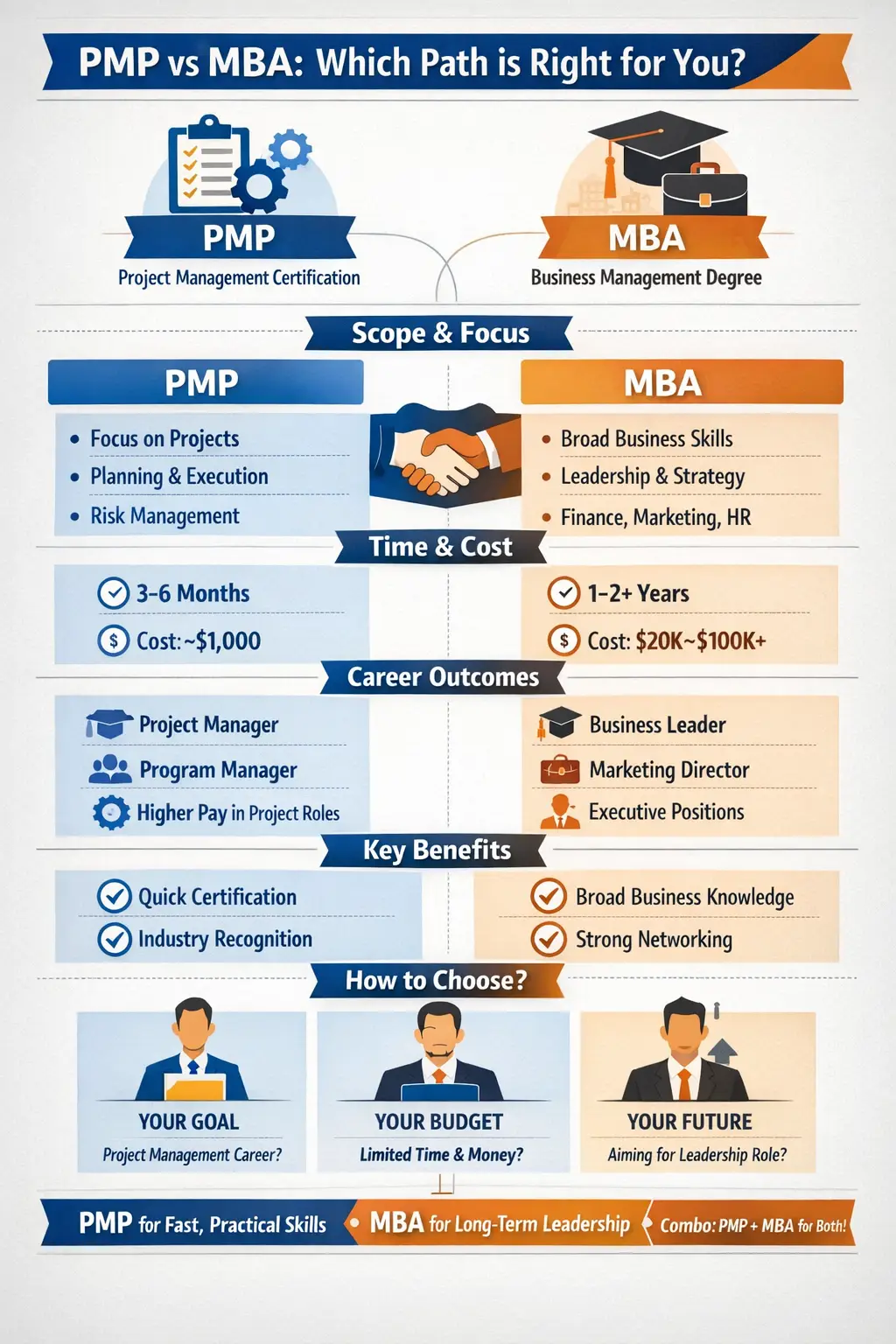
Choosing between a PMP and an MBA is not just about picking a certificate or a degree. It is about your career goals, time, money, and the kind of work you enjoy. Let’s break it down in detail to make this decision easier.
1. PMP: Fast Results and Practical Project Skills
If you want quick results and skills that you can apply immediately at work, PMP is a strong choice. The PMP certification focuses specifically on project management. That means you will learn how to:
- Plan projects efficiently
- Manage budgets and resources
- Handle risks before they become problems
- Lead teams and communicate clearly
The benefit of PMP is that it is very practical. You don’t spend years in a classroom learning general business concepts. Instead, you learn how to get things done in real projects, which makes you immediately more valuable to your employer.
For example, if you are working in IT, construction, or healthcare, a PMP can help you get promoted faster because your boss knows you can deliver projects on time and within budget. PMP is also cheaper and faster than an MBA, which is helpful if you don’t have years to invest.
However, remember that PMP is very focused. It won’t teach you broad business concepts like marketing strategies, finance, or leadership skills for running a whole company. If your goal is to manage an entire business or move into executive roles, PMP alone may not be enough.
2. MBA: Long-Term Leadership and Business Knowledge
On the other hand, if your goal is long-term growth, leadership, and understanding business at a high level, an MBA may be the better choice. An MBA covers finance, marketing, operations, strategy, and leadership. You will learn not only how to manage projects but also how to run entire teams, departments, or even companies.
MBA programs also provide valuable networking opportunities. Your classmates may become business partners or colleagues, and alumni networks can help you find leadership roles in the future.
MBA is a longer commitment, usually 1–2 years full-time or 2–3 years part-time. It is more expensive than PMP, but the investment can pay off if your goal is to move into higher management or executive roles.
Think about your career stage: If you already have experience in your field and want to switch industries, start your own business, or move into strategic leadership, an MBA can open doors that PMP alone cannot.
3. Combination: PMP + MBA
Some people choose to do both, which can be a smart strategy. Here’s how it works:
- First, get PMP certification to boost your current career. This gives you practical skills and credibility in project management.
- Later, pursue an MBA to gain broader business knowledge and leadership skills.
This combination is powerful. You get both immediate practical skills and long-term strategic growth. For example, you could start as a project manager with PMP and later move into a director or executive role with your MBA.
4. Industry Matters
Your choice also depends on your industry:
- PMP is highly respected in project-driven fields like IT, construction, healthcare, and engineering. Employers in these industries often prefer PMP-certified professionals because they know these individuals can manage complex projects.
- MBA is more valuable in general business, finance, consulting, marketing, and leadership roles. It is often required if you want to move into management positions, lead teams, or run a department or company.
For example, a software engineer might benefit more from PMP if their goal is to become a senior project manager, while someone in marketing might gain more from an MBA to eventually become a marketing director.
5. Personal Considerations
Beyond career goals and industry, ask yourself:
- How much time can I invest? PMP can take a few months. An MBA can take years.
- What is my budget? PMP is cheaper; MBA is more expensive.
- Do I enjoy learning theory or applying skills? PMP is practical; MBA mixes theory and practice.
- Do I want to stay in my current field or explore new areas?
It’s important to be honest with yourself. Choosing the wrong path can be costly in time, money, and opportunity. But the right choice can accelerate your career and open new doors.
6. Actionable Tips
Here are a few tips to make your decision easier:
- Write down your career goal in one sentence. For example: “I want to become a senior project manager in IT” or “I want to move into leadership in finance.”
- List your resources: Time, money, and energy you can dedicate to learning.
- Compare the outcomes: Think about salary, promotions, skills, and credibility.
- Ask people in your industry: Find mentors or colleagues who have PMP, MBA, or both, and learn from their experience.
Remember, this is not a one-size-fits-all decision. Your choice should reflect your career path, lifestyle, and personal goals.
Key Takeaways
- Choose PMP if you want fast, practical skills in project management.
- Choose MBA if you want long-term leadership, broader business knowledge, and networking.
- Consider both if you want practical skills now and leadership growth later.
- Factor in your industry—PMP for project-heavy industries, MBA for general business leadership.
- Think about your personal situation—time, money, and career goals.
By carefully considering these points, you can make a confident choice that accelerates your career and helps you achieve your goals.