


Six Sigma vs PMP: Which Certification is Right for Your Career in Project Management?
If you are a project manager or someone aspiring to enter the field, you’ve probably come across the terms Six Sigma and PMP. These two certifications are among the most prestigious in the world of project management, and for good reason. Each of them brings a unique set of skills to the table, focusing on different aspects of managing projects.
But Six Sigma vs PMP, which one should you pursue? This blog will help you compare both certifications, explore their core concepts, and guide you in deciding which is the best fit for your career goals.
Understanding PMP (Project Management Professional) Certification
The Project Management Professional (PMP) certification is one of the most globally recognized credentials for project managers. Administered by the Project Management Institute (PMI), PMP focuses on a structured, process-based approach to managing projects.
What is PMP?
PMP is a comprehensive certification that validates a project manager’s ability to handle projects from initiation to completion, regardless of industry. The certification emphasizes leadership, strategic thinking, and organizational skills. It offers tools and techniques for managing the various stages of a project and focuses on ensuring that projects are completed on time, within scope, and on budget.
Key Concepts Covered in PMP
PMP covers a wide range of topics necessary for successful project management. Here are the five key areas the certification addresses:
- Initiating the Project: This involves setting the scope, defining the project’s goals, and identifying stakeholders.
- Planning: PMP equips project managers with techniques to create effective plans, including defining the scope, work breakdown structures (WBS), schedules, and budget.
- Executing: This is where project managers guide the team, manage communication, and ensure that tasks are completed as per the project plan.
- Monitoring and Controlling: Managing and controlling scope changes, risks, quality, and budgets to keep the project on track.
- Closing: Ensuring that the project deliverables meet the requirements and closing it formally with documentation and feedback.
Why Choose PMP?
If you want to work in diverse industries such as IT, healthcare, construction, or finance, PMP is the go-to certification. It provides project management skills that can be applied across any sector. If you’re looking to manage large teams, control project budgets, and ensure projects are delivered successfully, PMP will provide you with the necessary tools and knowledge.
Overview of Six Sigma Methodology
Six Sigma is a methodology focused on improving the quality of processes by identifying and eliminating defects. It is often associated with manufacturing, but it is also applicable across many industries.
What is Six Sigma?
Six Sigma is a data-driven methodology that aims to improve processes by eliminating variability and defects, which results in higher quality and more efficient processes. The core idea behind Six Sigma is to strive for perfection by aiming to reduce process defects to 3.4 defects per million opportunities—this is where the name Six Sigma comes from, representing six standard deviations between the mean and the nearest specification limit.
DMAIC Framework
The Six Sigma process improvement methodology is centered around the DMAIC framework:
- Define: Identify the problem, define the project goals, and understand customer requirements.
- Measure: Collect data and measure the current performance of processes.
- Analyze: Use statistical tools to analyze data, identify root causes of defects, and understand process inefficiencies.
- Improve: Implement changes and process optimizations based on data analysis.
- Control: Maintain improvements by setting controls and monitoring performance.
Six Sigma Certification Levels
Six Sigma has various levels, which can be compared to belt systems in martial arts. Each level indicates the degree of knowledge and expertise in Six Sigma methodologies:
- Green Belt: A beginner-level certification that focuses on understanding Six Sigma tools and applying them in smaller projects.
- Black Belt: An advanced certification that focuses on deeper analysis, leadership, and process optimization across large projects.
- Master Black Belt: The highest level of certification, focusing on strategic implementation of Six Sigma across entire organizations.
Why Choose Six Sigma?
If you are looking to specialize in process improvement, quality management, and data-driven decision-making, Six Sigma might be the best fit for you. It is particularly valuable for individuals working in manufacturing, IT, healthcare, and any other industry focused on optimizing operational efficiency and quality.
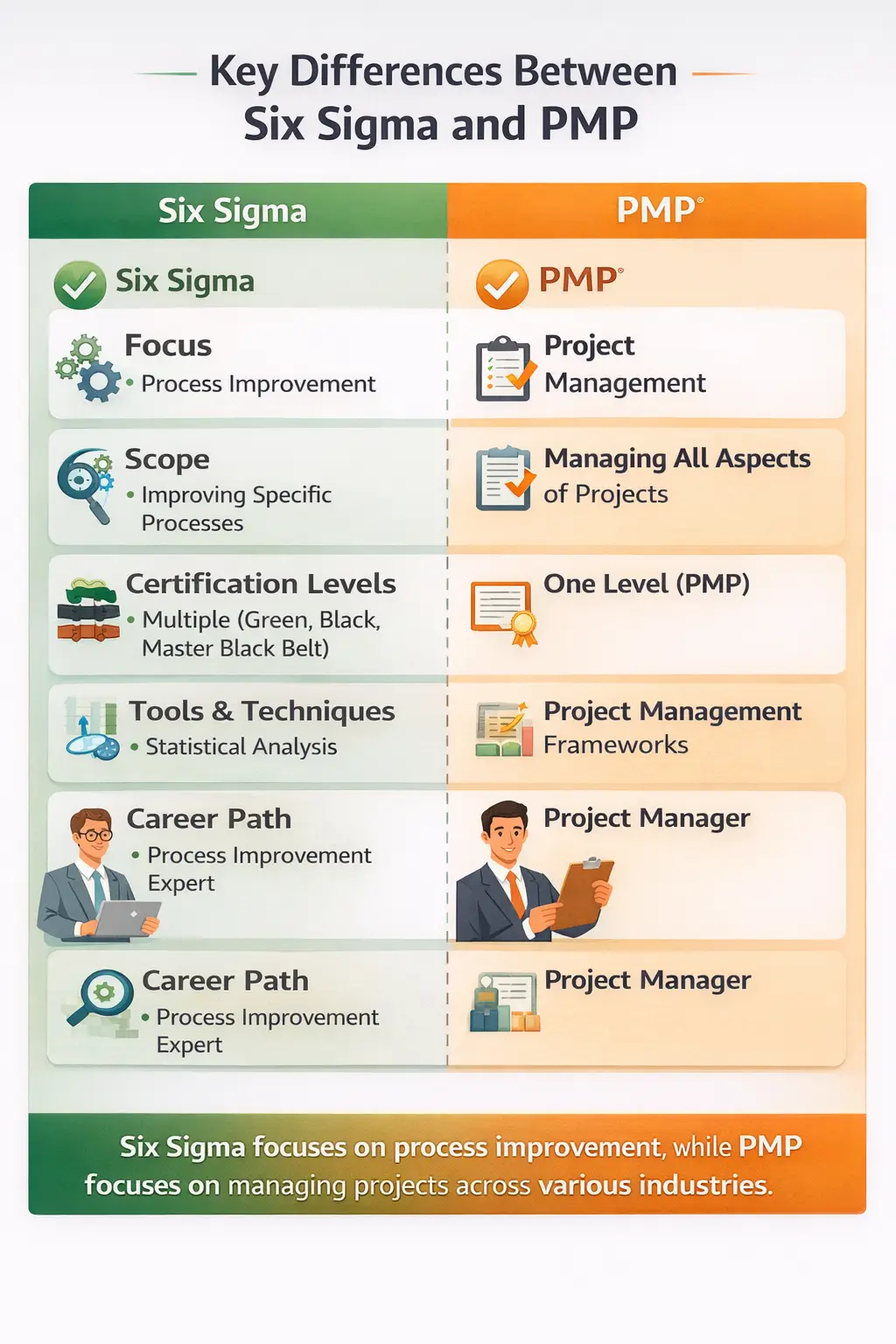
Key Differences Between Six Sigma and PMP
When you hear the terms Six Sigma and PMP, it’s clear that both are highly regarded certifications in project management, but they serve different purposes and are suited for different kinds of professionals. Let’s take a closer look at the key differences between Six Sigma and PMP to help you understand their unique features.
Focus of the Certification: Process Improvement vs. Project Management
Six Sigma: Process Improvement
Six Sigma focuses specifically on improving processes. Its goal is to identify and eliminate defects in processes, making them more efficient, effective, and consistent. This approach is often used to improve quality control and operational efficiency.
- Key Focus Areas: Process optimization, reducing variation, improving quality, and minimizing waste.
- Methodology: Six Sigma uses a structured method known as DMAIC (Define, Measure, Analyze, Improve, Control) to improve existing processes.
Example: In a manufacturing setting, Six Sigma might be used to reduce the number of defective products on the production line. In an office environment, Six Sigma can improve workflows to reduce time wasted on repetitive tasks.
PMP: Comprehensive Project Management
On the other hand, PMP is all about managing projects from beginning to end. It is not limited to improving processes but covers the entire project lifecycle, including initiation, planning, execution, monitoring, and closing.
- Key Focus Areas: Planning, managing resources, scope, schedule, and risks associated with the project.
- Methodology: PMP follows a process-based approach, which is governed by the PMBOK Guide (Project Management Body of Knowledge).
Example: If you’re working on a construction project, PMP will help you handle everything, from defining the project’s goals to managing resources, tracking progress, and ensuring the project finishes on time and within budget.
Scope: Narrow Process Focus vs. Broad Project Management Scope
Six Sigma: Narrow Focus on Specific Processes
Six Sigma has a narrower focus, often targeting specific processes within an organization. It’s perfect for professionals who want to specialize in process improvement and work on quality control or performance optimization in particular areas of business.
- Scope: Improving specific processes or operations in a company. For instance, you could use Six Sigma to improve customer service efficiency or supply chain performance.
- Application: It’s mainly used in manufacturing, service industries, and IT, though it can be applied anywhere there’s a need for quality improvement.
Example: In a call center, Six Sigma could help you reduce the average response time to customer inquiries by improving workflow and eliminating bottlenecks in the process.
PMP: Broad Project Management Scope
PMP, on the other hand, covers a broad range of project management tasks. It focuses on managing all aspects of any type of project, not just process improvement. As a PMP-certified project manager, you need to oversee projects from start to finish, ensuring all goals are met and the project is delivered successfully.
- Scope: Managing the entire lifecycle of a project, whether it’s large or small, simple or complex.
- Application: PMP is versatile and applicable to all industries, including IT, construction, healthcare, and marketing.
Example: As a PMP, you might be managing a hospital construction project, where you’re responsible for everything from gathering stakeholder requirements to scheduling workers, budgeting, and managing project risks.
Certification Levels: Multiple Belt Levels vs. One PMP Certification
Six Sigma: Multiple Certification Levels (Green Belt, Black Belt, Master Black Belt)
Six Sigma offers different certification levels that indicate the depth of your expertise. These levels are often referred to as belts, similar to martial arts. Here’s how it works:
- Green Belt: You’ll learn the basics of Six Sigma and apply it to smaller projects or as part of a team.
- Black Belt: Black Belts are experts who lead large projects, using advanced statistical tools and data analysis.
- Master Black Belt: This is the highest level and involves leading Six Sigma initiatives at a strategic level across the organization.
The higher the belt, the more advanced the knowledge and the greater responsibility you’ll have in leading projects.
PMP: One Certification Level
Unlike Six Sigma, PMP has only one certification level, but it’s a highly respected qualification. The PMP exam tests your knowledge in areas such as scope management, cost management, and quality control, ensuring you’re equipped to lead projects at various levels.
- Eligibility: To become PMP-certified, you need a certain amount of project management experience (typically 3-5 years), as well as 35 hours of project management education.
- Certification Level: PMP is one single certification that confirms your ability to manage projects across industries.
Example: Whether you’re a junior project manager or a senior one, the PMP certification applies to all levels, though experience requirements differ.
Tools & Techniques: Statistical Analysis vs. Project Management Frameworks
Six Sigma: Heavy Focus on Data and Statistical Analysis
Six Sigma uses data-driven techniques to improve processes. You will need to use a variety of statistical tools to analyze data, identify problems, and find solutions. This includes:
- Statistical process control (SPC)
- Hypothesis testing
- Regression analysis
- Control charts
These tools help you measure process performance and make data-backed decisions that improve outcomes.
Example: In a manufacturing company, Six Sigma might use control charts to monitor product defects and implement solutions when those defects exceed a certain threshold.
PMP: Focus on Project Management Processes
PMP, on the other hand, uses project management tools and frameworks, which include the PMBOK Guide as the core reference. This guide outlines best practices for managing various aspects of a project, such as:
- Work Breakdown Structure (WBS)
- Gantt charts for scheduling
- Risk management matrices
- Earned Value Management (EVM)
These tools are used to plan, track, and control project tasks, budgets, and timelines.
Example: For a large IT project, PMP could use a Gantt chart to ensure all tasks are completed according to the project timeline.
Career Paths: Process Improvement Expert vs. Project Manager
Six Sigma: Specialization in Process Improvement
With a Six Sigma certification, especially at higher levels (Black Belt or Master Black Belt), you’ll often work in roles like:
- Process Improvement Specialist
- Quality Control Manager
- Lean Manufacturing Expert
- Operational Excellence Consultant
Six Sigma professionals are in demand in industries that require constant improvement in processes, such as manufacturing, healthcare, and service industries.
Example: As a Six Sigma Black Belt, you might work as a process improvement consultant for an international company, focusing on optimizing global supply chain operations.
PMP: Broad Project Management Roles
In contrast, a PMP-certified professional can pursue a broad range of project management roles in any industry. Some typical roles include:
- Project Manager
- Program Manager
- Portfolio Manager
- Project Coordinator
Since PMP is not industry-specific, PMP professionals can manage projects in construction, IT, finance, marketing, or healthcare, and in various types of projects like software development or product launches. Interested in preparation? Check out the perfect study plan for PMP that outlines best schedule and prep resources.
Example: As a PMP-certified project manager, you might manage a software development project that creates a new mobile app, ensuring that the project stays within scope, on schedule, and within budget.
6. Application in Industries: Specific Focus vs. Versatility
Six Sigma: Ideal for Specific Industries
Six Sigma is particularly popular in industries that rely heavily on process optimization, such as:
- Manufacturing: Reducing defects in products and increasing production efficiency.
- Healthcare: Improving patient care processes and reducing wait times.
- IT and Software Development: Optimizing workflows and minimizing software bugs.
It’s a go-to certification for professionals in these sectors, especially those involved in quality control and process improvement.
PMP: Applicable Across All Industries
While Six Sigma is great for process-focused industries, PMP is widely applicable across all sectors. Whether you’re working in:
- Construction
- Information Technology
- Healthcare
- Finance
- Marketing
PMP will give you the tools and frameworks to manage projects successfully, regardless of industry.
Also read: What’s Difference Between PgMP and PMP Certifications?
4. Comparing the PMP Exam and Six Sigma Certifications
Both certifications require rigorous preparation, but they differ in their exam formats and content.
PMP Exam:
- Structure: The PMP exam consists of 180 multiple-choice questions. These questions test your knowledge on the PMBOK Guide (Project Management Body of Knowledge) and project management principles.
- Duration: The exam lasts for 4 hours.
- Preparation: To be eligible for the PMP exam, candidates must have 35 hours of project management education and meet certain experience requirements. Many candidates take formal courses or boot camps to prepare. To prepare effectively, use realistic practice questions for the PMP exam that present real exam scenarios and help you understand all domains of the exam.
- Difficulty: PMP is known for its challenging exam, and it requires a deep understanding of project management principles.
Six Sigma Exam:
- Structure: The Six Sigma exam varies depending on the certification level. A Green Belt exam may consist of 50-100 multiple-choice questions, while Black Belt exams are more comprehensive and may include case studies.
- Duration: Exams for Green Belt typically last 2-3 hours, while Black Belt exams can last longer.
- Preparation: Six Sigma candidates study using resources from organizations like IASSC (International Association for Six Sigma Certification) and ASQ (American Society for Quality). Black Belt exams often require deeper knowledge of statistical analysis tools.
- Difficulty: The exam is more focused on practical application of process improvement tools and statistical analysis.
How Six Sigma and PMP Complement Each Other
Though Six Sigma and PMP focus on different areas, they can be extremely complementary when used together. Here’s why:
PMP and Six Sigma: A Powerful Combination
- PMP provides you with a broad, project management-focused skillset that covers every stage of a project. It’s ideal for managing the overall direction and execution of a project.
- Six Sigma adds a layer of expertise in quality management and process optimization, particularly useful during the execution phase of projects to ensure the process runs smoothly and meets quality standards.
Real-World Application
Let’s say you’re managing a software development project. As a PMP-certified project manager, you handle the overall planning, scheduling, and resource management. However, during the project execution, you notice recurring quality issues in the code.
This is where Six Sigma comes in. By applying DMAIC, you can improve the development process, identify defects, and streamline workflows to ensure better quality output.
You might like to read: PMP vs MBA: Must-Know Differences
When Should You Choose Six Sigma, PMP, or Both?
PMP is best for those looking to manage a wide range of projects across various industries. It provides a comprehensive approach to project management, covering everything from risk management to stakeholder engagement. It’s ideal if you want to take a leadership role in projects and need a solid understanding of project management principles.
Six Sigma is perfect for professionals who want to specialize in improving processes, especially in industries that are focused on quality control and efficiency, such as manufacturing or IT. If you enjoy working with data and statistics to drive improvements in processes, Six Sigma is the ideal certification for you.
Both Certifications are valuable for anyone who wants to be well-rounded in project management. For example, if you are managing a large project that requires both high-level management skills and detailed process optimization, combining PMP and Six Sigma will make you a highly skilled project manager.
Common Myths and Misconceptions About Six Sigma and PMP
Myth 1: Six Sigma is only for manufacturing
- Fact: While Six Sigma was initially developed in manufacturing, its principles can be applied in healthcare, IT, service industries, and finance to improve process quality and efficiency.
Myth 2: PMP is only for senior project managers
- Fact: PMP is suitable for project managers at any level. Whether you’re just starting or you’ve been managing projects for years, PMP provides essential knowledge that will enhance your ability to manage projects effectively.
Myth 3: You need both certifications to be successful
- Fact: While both certifications offer unique benefits, you don’t need both. It’s best to evaluate your career goals and choose the one that aligns with your needs.
Conclusion
Choosing between Six Sigma vs PMP depends on your career goals and the specific skills you want to develop. If you’re looking to manage projects from a high level, ensuring their success across many industries, PMP is the right choice. However, if you’re interested in optimizing processes and improving efficiency within specific project areas, Six Sigma may be a better fit.
By understanding both certifications, you can make an informed decision about which one (or both) will best support your career aspirations.
Helpful article: CAPM or PMP: Which One is the Right Choice